Eight Principles for Building a Strong Foundation in the Teaching Profession
The first year of teaching is often described as one of the most rewarding and challenging experiences in an educator’s career. New teachers quickly discover that success requires much more than content knowledge and lesson planning. It demands professionalism, adaptability, empathy, and an unwavering commitment to students.
While every educator’s journey is unique, there are several foundational principles that consistently contribute to success during the critical first year in the classroom.
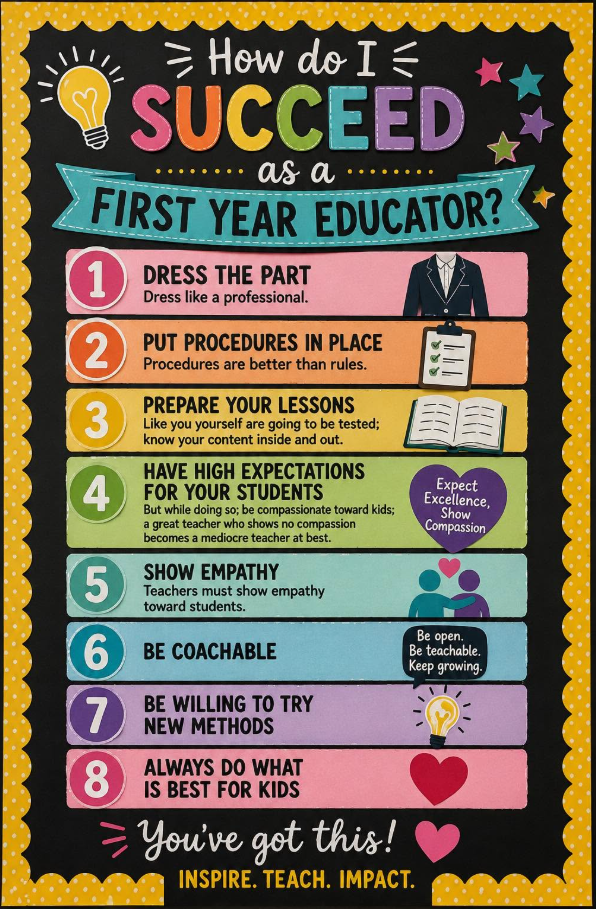
1. Dress the Part
Professionalism begins before a teacher speaks the first word of instruction. The way educators present themselves communicates confidence, credibility, and respect for the profession. While attire alone does not determine effectiveness, dressing professionally helps establish positive first impressions with students, families, colleagues, and community members.
Professional appearance reinforces the message that teaching is a profession worthy of respect and excellence.
2. Put Procedures in Place
Effective classrooms are built on procedures rather than rules. Rules tell students what not to do; procedures teach students how to do things correctly.
Successful teachers intentionally teach, model, practice, and reinforce procedures for everyday classroom activities such as entering the room, transitioning between tasks, submitting assignments, and participating in discussions. Clear procedures create consistency, reduce discipline issues, and maximize instructional time.
Students thrive when expectations are predictable and routines become habits.
3. Prepare as Though You Will Be Tested
One of the best pieces of advice for new educators is to prepare lessons as if they themselves will be assessed on the content. Effective teachers know their subject matter thoroughly and anticipate student questions before they arise.
Preparation extends beyond simply following a curriculum guide. It involves understanding standards, identifying misconceptions, planning meaningful learning experiences, and ensuring lessons are aligned to desired outcomes.
Confidence in the classroom is often the result of thorough preparation behind the scenes.
4. Maintain High Expectations While Showing Compassion
Students frequently rise to the level of expectations established by their teachers. Great educators challenge students academically and behaviorally because they believe in their potential.
However, high expectations must be balanced with compassion. Students face challenges that may not always be visible to others. A teacher who demands excellence while demonstrating understanding and grace creates an environment where students feel both challenged and supported.
A teacher with high expectations and compassion inspires growth. A teacher with high expectations but little compassion risks becoming ineffective despite good intentions.
5. Show Empathy
Empathy is one of the most powerful tools available to educators. It allows teachers to see situations from a student’s perspective and respond appropriately.
Showing empathy does not mean lowering standards or excusing poor choices. Rather, it means seeking to understand before responding. Students are more likely to trust, engage, and persevere when they know their teacher genuinely cares about their experiences and well-being.
Relationships remain at the heart of effective teaching, and empathy is the foundation of those relationships.
6. Be Coachable
The most successful first-year educators recognize they do not have all the answers. They seek feedback, ask questions, and remain open to guidance from mentors, administrators, and experienced colleagues.
Being coachable requires humility and a growth mindset. Every observation, conversation, and professional development opportunity becomes a chance to improve.
Great teachers are lifelong learners who continually refine their craft.
7. Be Willing to Try New Methods
Education is constantly evolving. Strategies that work with one group of students may not work with another. Effective educators remain flexible and willing to adapt.
New teachers should not be afraid to experiment with instructional strategies, technology tools, engagement techniques, and classroom management approaches. Innovation often emerges through thoughtful risk-taking and reflection.
Growth occurs when educators are willing to learn from both successes and failures.
8. Always Do What Is Best for Kids
Perhaps the most important principle of all is maintaining a student-centered focus. Every decision—whether instructional, disciplinary, or organizational—should be guided by a simple question:
“What is best for students?”
This guiding principle helps educators navigate difficult situations, prioritize effectively, and remain focused on their mission. Policies, procedures, and programs matter, but students must remain at the center of every decision.
When educators consistently act in the best interests of children, they build trust, strengthen school culture, and maximize student success.
Conclusion
The first year of teaching is not about perfection; it is about growth. New educators who embrace professionalism, establish strong procedures, prepare diligently, maintain high expectations, demonstrate compassion and empathy, remain coachable, embrace innovation, and keep students at the center of their work position themselves for long-term success.
Teaching is one of the most influential professions in society. The habits developed during the first year often shape an educator’s effectiveness for years to come. By committing to these eight principles, first-year teachers can build a strong foundation that benefits not only their careers but also the countless students whose lives they will impact.
Submitted by: Tony Clower
Role: Assistant Director of Schools, Roane County, TN

Bio: Tony L. Clower currently serves as the Assistant Director of Schools for the Roane County Schools in Tennessee. In this role, he provides instructional leadership and supervision for five middle schools, serves as the county athletic director overseeing five high schools and five middle schools, coordinates student support services, and leads school system safety initiatives as the district’s Safety Officer.
A lifelong resident of Roane County, Clower grew up in the Midway community and has dedicated his career to serving the students, educators, and families of his home region. He earned a Bachelor of Science in Secondary Education, a Master of Arts in Administration and Supervision, and an Education Specialist degree in Instructional Leadership from Tennessee Technological University.
Clower is married and has four children: Taylor, Caden, Lynnlee, and River. Outside of his professional responsibilities, he enjoys spending time with his family, running, and attending sporting events.
Throughout his career, Clower has been committed to fostering student success, supporting educators, promoting school safety, and strengthening educational opportunities for all students across Roane County.